Wednesday, July 27, 2011

East Germany Museum & A Stroll

Living in Berlin, Lisa and I thought we'd be crazy not to view the historical and cultural sights of the city. Since a lot of our home improvement projects are finished, last Saturday Lisa and I explored the DDR museum in Mitte, Berlin. The DDR museum is devoted to East Germany history from 1949 till its reunification with West Germany in 1990.

www.ddr-museum.de/en/

The DDR museum reports that it is careful not to glamorize the communist past of the DDR. There were exhibits that demonstrated East Germany's deplorable environmental record, Stasi interrogations, and grocery stores being constantly without important food staples. However, there were also a lot of exhibits showing fair wages for workers, inexpensive housing, and universal education.

This shows what a typical East German apartment might look like (from the DDR museum website):


After our time at the DDR museum, we also walked along museum island (I think it's called, because it is between two tributaries). We purchased two museum passes that enable us to get into 8-10 museums in Berlin.

Pictures taken along our walk:


Neues Museum


Statues of Marx & Engels


Photos Of Labor/Labor Unrest Next To Marx/Engels Statues

Thursday, July 21, 2011

Berlin


Lisa and I arrived in Berlin on June 13th after a wonderful honeymoon in Copenhagen, Denmark.

We quickly found a great balance: setting up the apartment, visiting friends (several of whom traveled from The Netherlands), setting appointments with various government offices for my assimilation into Germany, and relaxing together.

Over the next few weeks and months I plan to document my transition to Berlin, and to include the following topics:

1) German Bureaucracy

The stereotype about Germans being organized and punctual has been true in our experience....which has been wonderful. We have already completed the three steps necessary for my residency/work visa, and my passport was stamped this week with a 3-year work authorization.

2) Learning German

I finished Rosetta Stone disk 1, but am finding real-world spoken German and conversation to be more difficult. I will enroll in late August in a discounted German language and Germany integration course at a local college.

3) Apartment set-up

We have traveled to IKEA probably 4 times since I arrived in Germany. We have spent several Saturdays putting together furniture together (desks, chairs, bookshelf, wardrobe, etc.). We have found that we are a really great team when assembling furniture.

4) Church/community participation

We have attended 2 churches and were unenthusiastic. Germany, like other European states, provides money directly to a (Lutheran) church denomination. If a German taxpayer includes a Protestant denomination in their tax status, church taxes are taken out to support the Lutheran church. People can attend a state-supported church or choose another Protestant church (usually labeled generically as evangelical). The German people take seriously their summer breaks so the next 3 weeks churches near us don't even meet.

5) Mass Transit

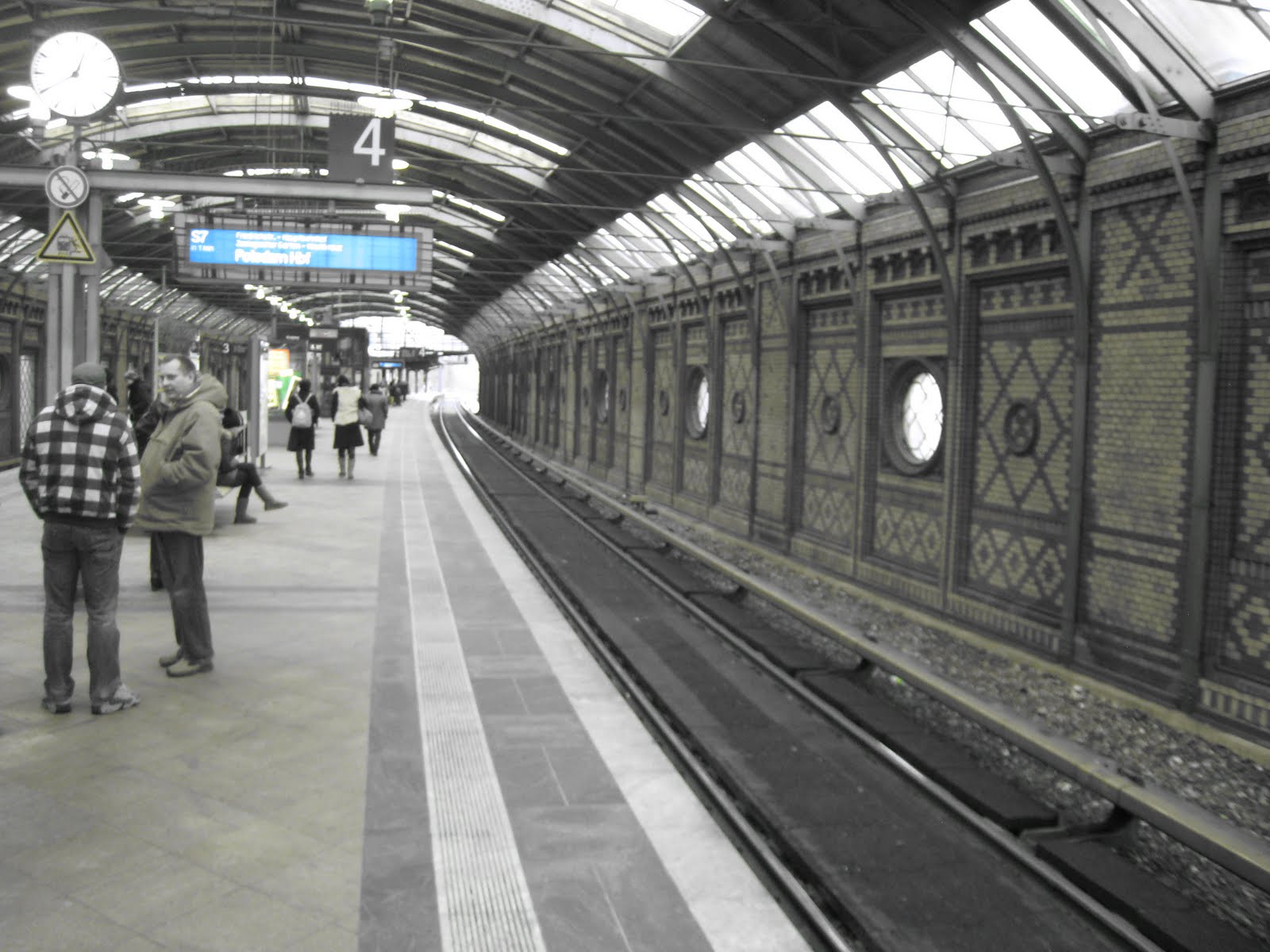
What a delight to be able to travel via bus, tram, subway and regional train throughout the city. (East Berlin has trams available, West Berlin does not). I have met Lisa in various parts of Berlin for shopping, meeting friends, and dinner. A standard 2-hour fare throughout most of the city costs 2 Euros 30 cents, however, I can ride for free on weekends with Lisa.

This image file of Berlin transit can be enlarged, I believe. We live close to the Schönhauser Alle station.


6) Applying for a Job
When looking for positions while in the USA, companies usually asked whether or not I already had my work visa. This was a question to filter applicants. Now that I have my residency and work visa, I applied for 3 jobs Thursday. English is only required.

7) German Food
What bad can be said about schnitzel and sausage? More to come...

8) Cultural attractions
Lisa and I had visited several cultural attractions and museums already in Berlin- from Checkpoint Charlie, the Berlin Wall, the Reichstag, etc. We hope in the next week or so to purchase a 1-year museum pass that will provide admission to most museums in Berlin.

Here is a photo of an art installation from repositioned sections of the old Berlin wall:


One of many stunning views in Berlin with historic architecture, a river running through the city, and sunsets.


Until receiving the work visa, I have stayed home and worked there. I have been responsible for groceries, cleaning, laundry, etc. I have been happy to undertake these tasks and Lisa jokingly says she'd like me to stay at home and not work because life is so much easier now. I am proudly, for now, a househusband, helping things to run smoothly and glad that Lisa is so talented at work and receives a good paycheck.

Wednesday, March 23, 2011

Georgia On My Mind

I had the opportunity to travel to Georgia a couple weeks ago to visit my recently retired parents. They moved about six months ago and are loving the warm weather, being with cousins, and the southern cooking. They also love that many people have already signed up to visit them and have poured in from Wisconsin, Illinois, Nebraska, and other places.

This area of Georgia we, as a family, had a chance to travel to every year during the summer and some years for New Years as well. Nanny (mom's mom) and a lot our great aunts and uncles and their kids lived in this area. This was where we fished, put coins on the railroad tracks, caught frogs and lizards, swung from ropes off ledges into a lake, picked up coal and turtle shells while walking the railroad tracks, played Scrabble, ate creamed corn and squash and okra and biscuits and gravy, drank sweet tea, picked wild blackberries along a logging trail, investigated abandoned houses, and listened to the crickets and felt the warm breeze through window screens as we fell asleep.

I always thought that this area was Buchanan, GA about an hour west of Atlanta and 25 minutes east of the Alabama border. I just learned that the area is called Flatwoods, as it isn't Buchanan proper. What is a more perfect rural name than Flatwoods?

Mom and dad are situated on about 10 acres with a house and small workshop that has been converted to a guest house. It is exquisite. They are surrounded by woods and dad recently planted a garden. This all fits them perfectly. Mom and dad also have a pond that they just stocked with fish.

I took some pictures while there, but as usual, wish I took more. So much has changed since my first memories of the area, from the early 80's. Gravel roads have become paved, railroad ties that served as small bridges have become concrete, and houses lived in at the time have been overrun with termites and abandoned.

The pictures below of houses are ascribed to former owners, owners that have passed away.


Aunt Olive's house


An abandoned house along M. Sanders Rd.


The logging trail where we hiked and picked wild blackberries.


Nanny's house


Reported to be a blacksmith shop from yesteryear


Walking along the railroad tracks; overlooking the Tallapoosa River, I believe


The lake behind Aunt Olive's

Some other places mom, dad, and I walked or drove by are: Aunt Marie's house (hardly visible and overgrown by tree saplings), Uncle Stanley and Aunt Ruth's house, Uncle Sephord and Aunt Ruby's house, the old sharecropper house (as the story goes) on land passed down to the Philpot girls, a logging trail that would lead to where Calvin Philpot (granddaddy) had a heart attack and died, the Buchanan Historical Society where Nanny worked, an Indian Trail tree, Piggly Wiggly, Mt. Vernon Baptist Church, and the graves of Nanny, Calvin and many other family members already named above. Mt. Vernon has had a number of different renovations and doesn't 'smell' the way it used to (wood burning, rural smell) but it was still nostalgic to see.

A big thanks to Steve & Carol and Wiley & Beth for their home cooking and hospitality and Kathy & Chuck, Betty Ann & Ray, Mary Allis and others for their warmth and great conversation.

Sunday, March 6, 2011

Shows largest part of our current budget deficit is attributable to Bush tax cuts:

Thursday, February 24, 2011

Micro and Macro

After the Great Recession, I noticed fear(s) on both a country-level and an individual level that were expressed similarly as questions of identity. I've found that during difficult times, there is a natural self-analysis; individuals and countries become introspective. They look back to when times were better, try to guess where the future is headed, and compare themselves with others around them.

Some of the questions asked:

1) Who am I? Who are we?

After a layoff and during a recession, there is a search for identity. Who am I and what do I bring to the table? In the absence of familiarity (I fulfill a need at my job for which I am paid), there is a subconscious search for: what do I provide that people value?

As an individual, this question is asked specifically: what are my strengths, what are my weaknesses, what are my opportunities?

As a country, I see the questions being asked: Who are we as a people? Are we going in the right direction? Many long for the past, and remember an idealized version of themselves. American Exceptionalism has been touted recently by conservatives; this ideology is an answer to an identity question. While American Exceptionalism doesn't necessarily tout superiority, my sense is that it's recent ideological re-emergence is designed to answer the angst-ridden questions: how am I different than other countries, what are my competitive advantages?

When sports teams lose, they search for their team identity. Countries become nostalgic and think about better times in the past. I've talked with people in former communist countries that longed for a return to communism because of full employment and people in former colonial countries that longed for a return to colonial (British, etc.) rule. Memories can often emphasize only the most positive attributes of the past and the other associative memories, long bread lines and an inability to vote, are forgotten. In the US, I've heard people long for days of old. These issues are mentioned as: the return of manufacturing jobs for high-school graduates, prayer in classrooms, and the workforce comprising one working parent and the other parent staying home with the children.

2) When was I doing well, what were the ingredients that made it a success? When was the US doing well?

As a country, we look back to the post WWII period, or parts of the 90's. Sectors that were doing well then (manufacturing, financial, housing) are not doing well now. So what is missing now?...is it that jobs were outsourced (common complaint), immigration took jobs (common complaint), taxes are too high to foster hiring (common but inaccurate complaint because taxes have gone down steadily since the 40's), technology is making jobs obsolete (most common source of jobs being lost, but Americans theoretically champion 'creative destruction' brought by technological innovation), entrepreneurship isn't being championed, or different environmental standards that allow foreign companies to produce at a lower cost (common complaint).

Besides looking nostalgically at the past, there is a personal inventory that takes place to examine if the ingredients are right for current success. Do I need retraining, do I need to enter a different career field, will I be perceived as being 'hungry' enough for the job to compete with 20 year old's?

3) Where can I cut costs?

Many families that did not experience job losses, still cut costs because of job loss uncertainty. Economists want people to re-balance their debt to income ratios, to spend less and save more, but don't want too many people doing that at the same time. On a macroeconomic level, if everyone starts saving more, then the economy, which is 70% based on US household consumption, will experience a significant drag. Remember after 9/11 that Bush and Giuliani implored people to go out and shop.

State governments, some of which are toying with bankruptcy, are cutting budgets drastically. The federal government can print money so it has not made the hard choices yet.

4) How many people am I competing with?

One of the most coldly calculating questions that people ask is: How many people am I competing with. Large, well-respected corporations often publish that thousands of applications are received for every job posting.

In cities where manufacturing jobs have left, there are even more applications per vacancy. Think Flint, Detroit or Battle Creek, MI. People become discouraged and move from places like Michigan to places like Florida because the odds are just too difficult when competing with hundreds of other people for each job. Workers along the Mexico border worry that the dry-walling, roofing, or contractors they've done in the past may be bid by other entrants into the marketplace.

5) Will someone underbid me?

Business owners I know, even in relatively good markets, think about if someone will underbid them on a job. They do not engage in collusion, but when they hear the bids that are accepted on jobs, they know that the winning firm will not only not make any profit, but may accept a loss in exchange for future business or to keep employees employed.

Both individuals and country's are asking themselves if they can compete against the lower costs/prices of competitors no matter how productive they are. A US worker asks if they can compete with someone from India (is the American __ times as productive to offset what an Indian worker may be paid?); the US asks if it can compete against the lower prices of the yuan/RMB of China. Countries, including the US, are now competing on how much to devalue their currency to encourage export growth. Countries like Vietnam just devalued their currency, to provide a competitive advantage for exports.

Our economy has become so commoditized that businesses and consumers often have this conversation:

Consumer: What is the cost of this?
Business: We're not selling a product; we're selling a service. We provide "this" level of customer service, "this" level of quality.
Consumer: I get that line from every business. They can't compete on price so they demonstrate their value-added services. What is the cost?

6) Where will the jobs be in 40 years?

No one knows. Some economists believe that only high-knowledge, high-skill jobs will survive. Other economists believe these jobs are precisely the jobs that will be usurped by robots/computers/technology. Most industries do more with less than 50 years ago. Fewer employees are needed to accomplish the same jobs. Will this lead to chronic unemployment in the future?

Monday, January 31, 2011

Berlin December 2010

I have such great memories of being in Berlin in early December. It was a quick trip, financed by frequent flier miles; I had just enough time to propose. Lisa said "of course!".


Our romantic dinner the night of the proposal.


Beautiful in every setting

Monday, January 10, 2011

Give It A Rest Uwe!

When I was a junior in high school, we had a German exchange student. He was everything you'd think of in a stereotypical German guy- hefty, looks like he's 40 only he's 17, has a 5 o'clock shadow at noon, has graying wavy hair, and I feel like he was wearing lederhosen (but that might just be to show off that he was an exchange student). He came in on the first day of choir, sat down at the piano before the start of class and started playing and singing in this rich baritone voice. He sang operatically and the sound filled the choir room. Students felt as though they were being welcomed into class and ushered into this new choir history. They applauded for him after the bell rang.

Cut to one week later....Uwe (pronounced Uva to lame English speakers), continues to play and sing and serenade the class until one student, sensing the rising sentiment of disgust, yells out: "Give it a rest Uwe!!"

No more playing piano or singing after that. (except in choir and in the multiple solos the choir director gave him).

In honor of Uwe, I looked up hefty guy playing a piano on Google and found this:


I know Uwe would have been much more dignified.